
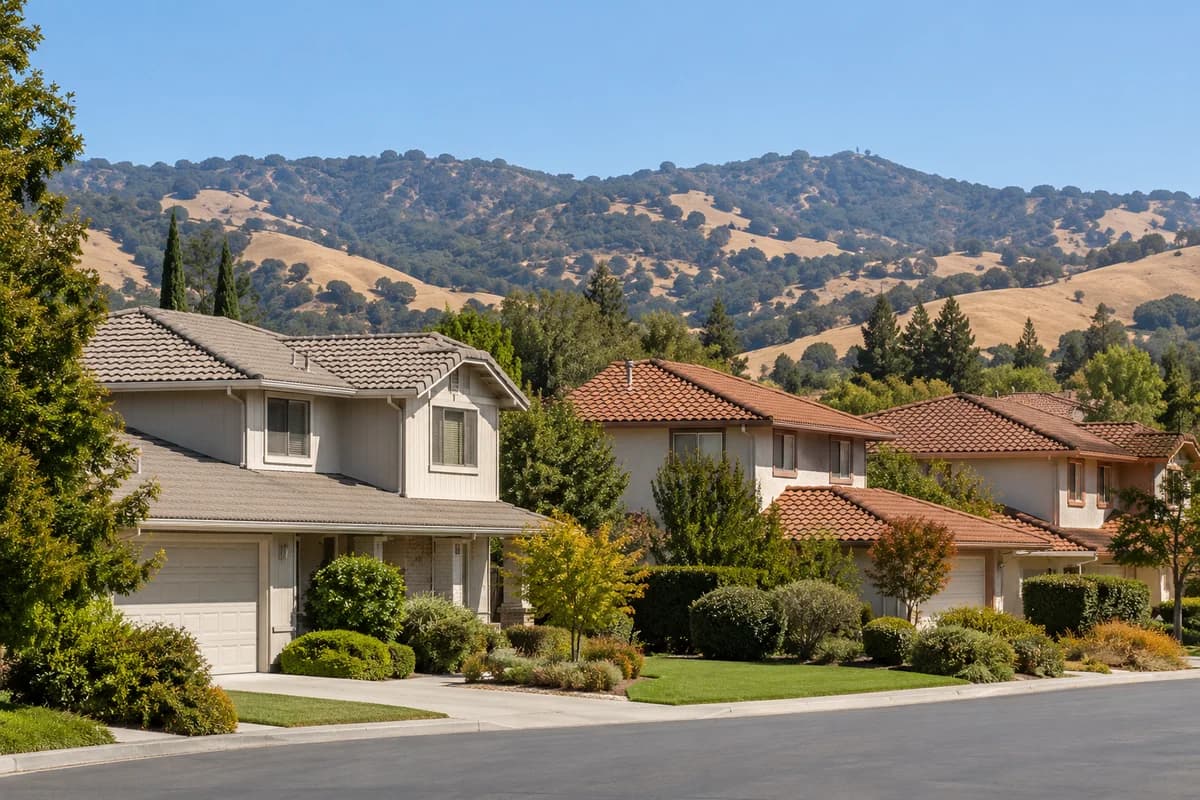
What we see on Cupertino roofs
Concrete tile and composition shingle cover most of the city. The 1960s and 1970s tracts east of 85, around Garden Gate and the streets between Stevens Creek Boulevard and Bollinger Road, have been re-roofed at least once. On a tile roof the tile is not the wear item. The underlayment is. Felt laid under tile in the 1980s and 1990s goes brittle and lets water reach the deck while the tile above still looks new. The fix is a lift and re-lay: stack the sound tile, strip the old felt, repair the deck, install new underlayment and flashings, then reset the tile.
Fairgrove is Cupertino's Eichler neighborhood, zoned R1-e. Eichler homes have flat or very low-slope roofs, often over exposed decking that doubles as the ceiling, so there is no attic to hide a leak. They take a membrane or foam system, not shingles, and the city's instant re-roof permit excludes them, so the job goes through a standard permit.
Rancho Rinconada, on the east edge between Stevens Creek Boulevard, Miller Avenue, Bollinger Road and Saratoga Creek, started as 1950s ranch houses and was annexed to Cupertino in 1999. Since the mid-1990s many originals have been replaced by two-story homes. In the western hills, Inspiration Heights and Oak Valley add steep access, heavy tree debris and fire hazard zone rules that decide which roof assemblies are allowed.
- Common materials
- Concrete tile and composition shingle on the valley floor, membranes and foam on Eichler homes, Class A assemblies in fire hazard zones.
- Typical house age
- About 47 percent of homes built in the 1960s and 1970s, roughly six in ten before 1980 (ACS 2020 to 2024).
- Permits
- Required for every re-roof. Licensed contractors can pull a like-for-like residential re-roof as an instant permit through the city's Accela portal. Eichler, HOA and historic homes need a standard permit.
- Rainy season
- Mostly October through mid-May, wettest December through February, about 14.5 inches a year.
Roofing services in Cupertino
Cupertino weather and your roof
Winter rain
Cupertino gets almost all of its rain between October and May, most of it from December through February, often in a few strong Pacific storms. A roof that sat dry for six months takes the first one hard: cracked pipe boots, debris-packed valleys and brittle tile underlayment all show up at once. Leak calls spike after the first heavy rain, so a September or October inspection is the cheapest visit of the year.
Summer heat and sun
July and August are the hottest months, with average highs in the low 80s and a dry season that runs from June into October. Months of sun strip granules off composition shingles, dry out flat-roof seams, and open joints in flashing. Many 1960s houses have undersized attic ventilation, and adding ridge and eave vents during a re-roof extends the life of the new shingles. On Eichler flat roofs, a light-colored membrane or reflective coating helps inside.
Wind and fire season
The windier months run from March into July, and homes on the western slopes sit more exposed than the flats, so lifted shingle tabs and slipped ridge tiles are common there. The city names the foothills of west Cupertino as its wildland-urban interface, and in June 2025 the City Council adopted CAL FIRE's updated fire hazard severity zone maps. Inside a mapped zone, the California Residential Code requires a roof covering rated at least Class A whenever more than half the roof is replaced within a year. Concrete tile, Class A composition shingle and metal qualify. Wood shake does not. Tile roofs there also need bird stops at the eaves and a heavy cap sheet or rated underlayment beneath, so embers cannot lodge under the tile.
| Month | Jan | Feb | Mar | Apr | May | Jun | Jul | Aug | Sep | Oct | Nov | Dec |
|---|---|---|---|---|---|---|---|---|---|---|---|---|
| Rain (in) | 3.46 | 3.92 | 2.4 | 1.19 | 0.39 | 0.18 | 0.01 | 0.12 | 0.09 | 0.94 | 1.57 | 3.51 |
Where we work in Cupertino
Contractors on this site cover the whole city, including:
- Monta Vista. West of Highway 85 around Bubb Road and Foothill Boulevard, older ranch homes and two-story rebuilds under shingle and tile, plus the small Monta Vista Village commercial strip.
- Fairgrove. The R1-e Eichler tract, where flat and low-slope roofs take foam or single-ply membranes and every re-roof goes through a standard city permit.
- Rancho Rinconada. East edge of the city, 1950s single-story ranch houses next to two-story replacements built since the mid-1990s.
- Garden Gate. Mid-century tract homes west of North De Anza Boulevard near Lawson Middle School, most re-roofed with composition shingle or concrete tile.
- Inspiration Heights. Hillside homes along Foothill Boulevard and Stevens Canyon Road, with steep access, heavy tree debris and fire hazard zone roofing rules.
- Oak Valley. Clustered hillside homes among preserved open space, where city hillside rules call for natural materials and colors and the fire map calls for Class A assemblies.
- Stevens Creek Boulevard. The Heart of the City corridor, shopping centers, mixed-use buildings and offices with low-slope roofs full of HVAC curbs and drains.
- North De Anza Boulevard. The city's office corridor north of Stevens Creek Boulevard, with flat commercial roofs that are maintained on a schedule.
Permits and licensing
Re-roof permits in Cupertino go through the City of Cupertino Building Division. The contractor normally pulls the permit; the quote should say whether it is included.
California roofing contractors hold a CSLB C-39 license. Check any license number on the CSLB site before signing. Look up a license.
How it works
1Request an estimate
Call the Cupertino line or send the form.
2A local roofer inspects
Roof, flashings, gutters and attic where possible.
3You get a written quote
Scope, materials and price on paper. No obligation.
Commercial roofing in Cupertino
Cupertino is mostly houses, but commercial roofing concentrates in a few places. The Heart of the City corridor along Stevens Creek Boulevard holds the shopping centers and mixed-use buildings, North De Anza Boulevard is the office corridor, and Bubb Road carries the older commercial and industrial buildings. Apple Park occupies the former Pruneridge Avenue campus site, and De Anza College, open since 1967, adds institutional roofs. Nearly all are low-slope: single-ply, modified bitumen, and older built-up roofs under coatings, with ponding at clogged drains and splits at HVAC curbs as the common problems.
For property managers, the roofers listed for Cupertino handle assessments with photos and core samples, maintenance visits before the October rains, coatings to extend a sound roof, and full replacement when the insulation is saturated. Commercial work needs a standard permit with plan review.
Cupertino roofing questions
Do I need a permit to re-roof my house in Cupertino?
Yes. Every re-roof needs a permit from the City of Cupertino Building Division. For a like-for-like residential re-roof on a non-historic home with no HOA, a licensed contractor can pull an instant permit through the city's Accela portal. Eichler, HOA and historic properties need a standard permit. The contractor pulls the permit and schedules inspections. If a quote does not list it, ask why.
My house is in the foothills. Does the fire hazard map change what roof I can install?
It can. The City Council adopted CAL FIRE's updated local fire hazard severity zone maps in June 2025, and west Cupertino's foothills are the city's wildland-urban interface. Check your parcel on the city's map. Inside a mapped zone, state residential code requires a roof covering rated at least Class A whenever more than half the roof is replaced in a year. Concrete tile, Class A composition shingle and metal all work. Wood shake is out.
I own an Eichler in Fairgrove. What are my roofing options?
Eichler roofs are flat or nearly flat, often over exposed decking with no attic. The usual choices are sprayed foam with a topcoat, modified bitumen, or a single-ply membrane such as TPO, often with rigid insulation added above the deck. Fairgrove is zoned R1-e and the city's Eichler design guidelines apply, so keep the low roof edge and original profile. The instant permit does not cover Eichler homes, so plan for a standard permit.
My 1970s tile roof looks fine but leaks every winter. Why?
Because the tile was never the waterproof layer. The underlayment was, and after decades of heat it has gone brittle and cracked, usually first at the battens, valleys and pipe penetrations. Patching the worst spot buys a season. The lasting fix is a lift and re-lay with new underlayment and flashings, reusing the sound tile and swapping broken pieces with salvaged matches. Ask the roofer for photos of the old felt.
A storm just started a leak. What happens when I call?
Say the word leak when you call. A local roofing contractor will usually set a tarp first, then trace the source once the roof is dry enough to walk safely. The usual culprits are cracked pipe boots, debris-packed valleys, chimney flashing on 1960s homes, and failed seams on Eichler flat roofs. You get a written report with photos, which is also what your insurer will ask for.
What drives the cost of a roof in Cupertino?
Roof size and pitch, the material, how many old layers come off, and how much decking needs repair once the roof is open. On tile roofs, whether the tile can be reused matters most. Hillside homes add access costs, fire hazard zones add cap sheet and bird stops, and solar panels come off and go back on under a separate permit. Ask for each as a separate line on the quote.
Nearby areas
- Census Reporter, ACS 2020-2024 5-year, Table B25034 Year Structure Built, Cupertino city
- City of Cupertino General Plan, Chapter 3 Land Use and Community Design Element (planning areas, hillsides, Fairgrove R1-e)
- City of Cupertino General Plan, Chapter 7 Health and Safety Element (fire safety, wildland-urban interface, major corridors)
- City of Cupertino, Wildfire preparedness (west Cupertino foothills WUI, June 2025 adoption of LRA fire hazard maps)
- City of Cupertino bulletin, CAL FIRE's updated fire hazard map for Cupertino's response area (March 2025)
- City of Cupertino Building Division
- City of Cupertino, Instant Permits (Residential Only), re-roof eligibility
- City of Cupertino, Single Family Residential Developments (R1-e Eichler zoning district)
- California Residential Code, Section R902.1.1 Roof coverings within fire hazard severity zones (UpCodes)
- California Building Code, Chapter 7A, Section 705A Roofing (UpCodes)
- Wikipedia, Cupertino, California (geography, climate, Apple Park, De Anza College, neighborhoods)
- Wikipedia, Rancho Rinconada, Cupertino, California
- WeatherSpark, Average Weather in Cupertino, California (rainy period, windier months)