
Signs you need metal roof installation
You are replacing the roof anyway and want it to last
If your shingles or the underlayment under tile are at the end of their life, the tear-off cost is already in the budget. Metal adds the panel cost but can avoid another replacement later.
Wildfire, hail or heavy snow is a regional concern
Metal panels can carry a Class A fire rating as an assembly, and an ember has nothing on the surface to ignite. Snow slides off easily, and many panels carry hail impact ratings. Ask for the rating of the exact product.
You have a low-slope section that keeps leaking
Porch roofs and additions with a shallow pitch are hard to keep dry with shingles. Mechanically seamed standing seam panels are rated for lower slopes than most other steep-roof materials.
You want a cooler house without more insulation work
Light colored or cool-rated metal reflects more sunlight than dark shingles. Combined with an air gap over battens and proper attic ventilation, it can lower attic temperatures on hot afternoons.
You are building an addition or a modern home
Metal suits shed-style and modern rooflines and goes on quickly.
How the work is done
1Site visit and measurement
The roofer measures every plane and notes the pitch, penetrations, existing material and attic ventilation. The panels need a sound, flat deck.
2Panel, gauge and finish selection
You choose between standing seam and exposed-fastener panels, pick a steel gauge or aluminum, and choose a finish color. Ask for samples and the finish warranty.
3Permit, license and HOA approval
Each city or county sets its own permit rules, and a re-roof usually needs a permit. Some states license roofers and some do not, so check the state board where one exists, plus insurance and local registration. If you are in an HOA, submit the color and profile for review before ordering material.
4Tear-off and deck repair
The old roof comes off down to the deck. The crew replaces rotten or delaminated sheathing and fixes any framing problems.
5Underlayment and ventilation
A high-temperature synthetic or self-adhered underlayment goes down first, because standard felt can degrade under hot metal. In snowy regions, an ice barrier goes at the eaves. Eave intake and ridge exhaust vents are confirmed or added at this stage.
6Panel installation and flashing
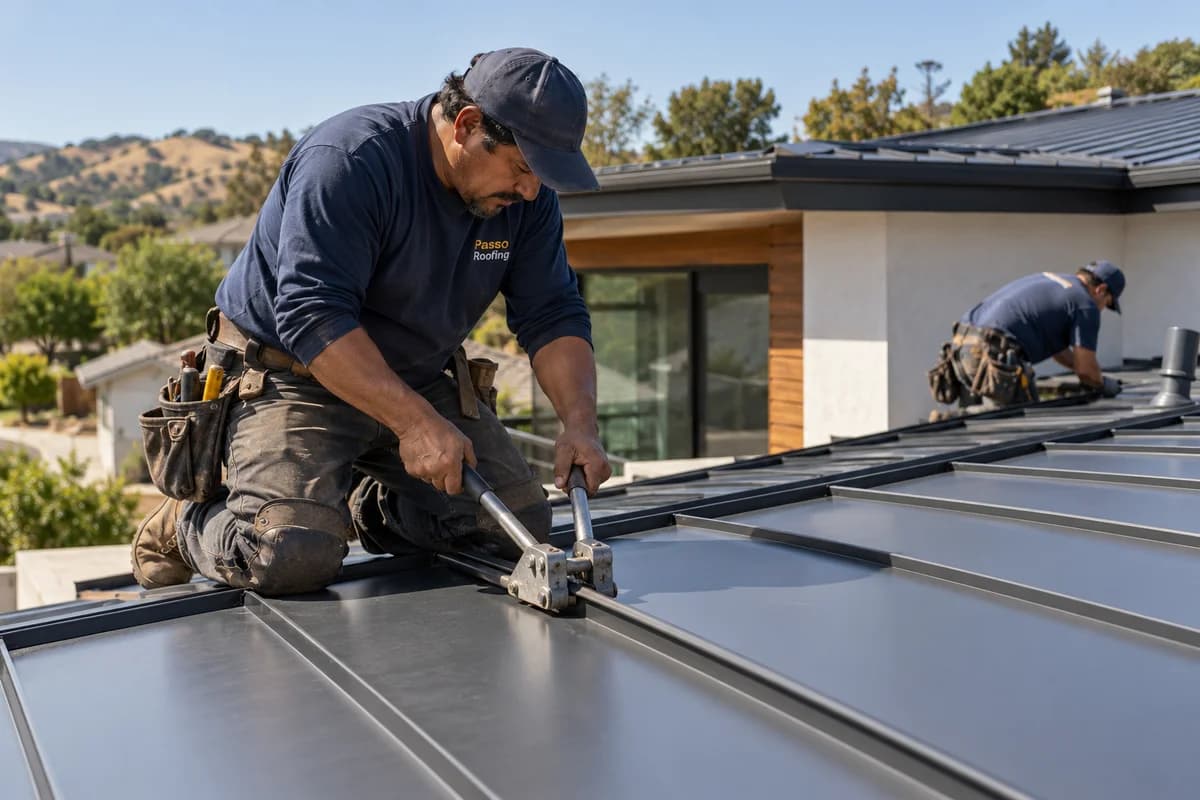
Panels run from eave to ridge. Standing seam panels are clipped to the deck and seamed, which lets them expand and contract. Flashing at walls, chimneys and valleys is bent to fit on site and is where most of the skill goes. In snow country, snow retention bars or guards go on above doors, walkways and lower roofs.
7Final inspection and paperwork
Where a permit was pulled, the inspector signs it off. You receive the finish and workmanship warranties.
What affects the cost
No two roofs price the same. These are the things a written quote should list separately so you can compare one contractor with another.
Panel type
Standing seam with concealed clips costs more than exposed-fastener panels because of the panel, the clips and the seaming labor.
Metal and gauge
Thicker steel, a lower gauge number, costs more and resists denting and oil-canning better. Aluminum resists corrosion, which matters near salt water, and is priced differently from steel.
Finish and coating
A PVDF finish, often sold as Kynar, holds color longer than a polyester paint and is priced accordingly. Unpainted Galvalume is the lowest cost finish and weathers to a dull gray.
Roof complexity
Hips, valleys, dormers, skylights and many penetrations mean more cuts, more trim and more flashing. A simple gable is the cheapest shape to cover.
Deck condition, accessories and local code
Sheathing replacement, battens for an air gap, ventilation, snow guards and fastening upgrades for high-wind areas are added to the quote as they are found or required. Local codes on wind, snow load and fire change the list.
Repair or replace?
Metal roofs are repaired by the panel, not by the square foot. On an exposed-fastener roof the usual repairs are replacing backed-out or corroded screws with larger ones, resealing laps and replacing a dented or rusted panel. On a standing seam roof a single panel can be unclipped and swapped if the profile is still made.
Replacement makes sense when the finish has chalked and rusted across most of the roof, when fastener holes have widened so far that new screws will not seal, or when leaks show up at many seams. Watch for galvanic problems too: copper or treated lumber touching bare steel or aluminum can corrode it, so flashings and fasteners should be compatible metals. A local roofing contractor can tell you which case you have after a walk on the roof.
Questions about metal roof installation
Is a metal roof loud when it rains?
Not on a house. The noise people remember comes from barns and sheds where the metal sits on open purlins. A residential metal roof goes over a solid deck, underlayment and attic insulation, so rain sounds much like it does on a shingle roof.
Does metal make the house hotter in summer?
Usually the opposite. Metal reflects more sunlight than dark asphalt shingles, and a light or cool-rated finish reflects even more.
What is the difference between standing seam and exposed-fastener panels?
Standing seam panels lock together at raised ribs and are held by hidden clips, so no screws pass through the surface. Exposed-fastener panels are screwed through the metal with gasketed screws. Standing seam costs more but has no exposed screws to loosen and reseal.
Will my HOA allow a metal roof?
Many do, but most require review of the color and profile. Some states limit what an HOA can ban, especially for fire-resistant or energy-saving roofing, but rules differ. Read your HOA documents, ask the contractor what has been approved nearby, and submit a sample before you order.
Can a metal roof go over my existing shingles?
Some codes allow it over one existing layer, usually on battens, and others do not. Most roofers recommend a tear-off so the deck can be inspected. Check your local code and ask what the warranty requires.