
Signs you need tile roof repair & replacement
Cracked, slipped or missing tiles
A tile that has slid down, a visible crack or a gap in the pattern exposes the underlayment to sun and rain. A few pieces is a repair. Many suggests failing fasteners or battens.
Leaks with tile that looks perfect
This is the classic sign of underlayment failure. The tile is whole, but water finds cracks in the aged sheet below and shows up as a ceiling stain.
Damage after someone walked the roof
Satellite installers, solar crews, painters and chimney sweeps crack tile when they step in the wrong place. If a trade has been on your roof, look for fresh cracks along their path.
Flaking, spalling or frost damage
Tile that sheds flakes from its face, or chips at the edges after a cold winter, has absorbed water and frozen. Either the tile is wrong for your climate or it is worn out.
How the work is done
1Inspection, including lifting tile
The roofer walks the roof carefully, stepping where each tile is supported, and lifts tiles in a few places to see the underlayment. In the attic they look for deck stains.
2Written quote with options
The quote should lay out the choices: spot repair, re-lay or full replacement. It names the underlayment product, the flashing metal and whether your existing tile will be reused.
3Permit, license and insurance check
Each city or county sets its own permit rules, and a re-lay or replacement usually needs one. Some states license roofers and some do not. Where a state board exists, look the contractor up there, then confirm insurance and any local registration.
4Lift and stack the tile
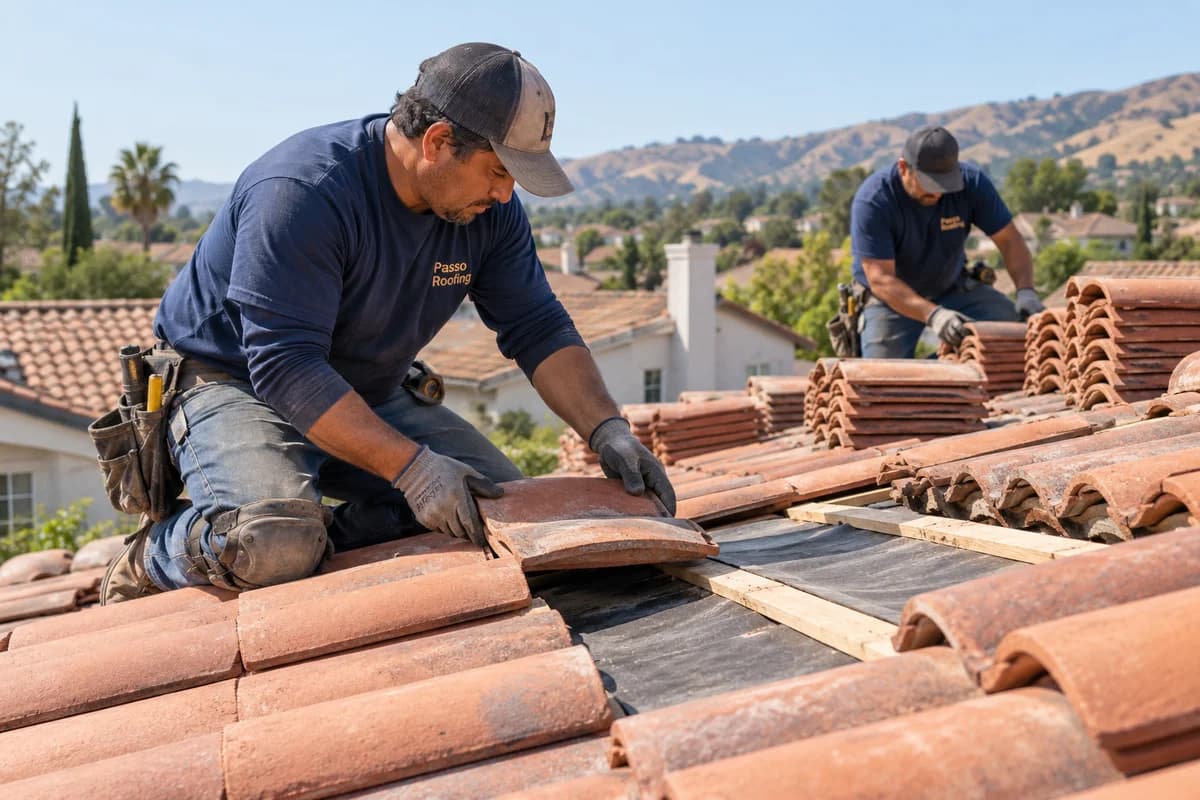
For a re-lay, the crew removes tile in sections and stacks it on the roof or on pallets. Broken pieces are counted, which shows how many replacements are needed and whether the profile is still made.
5Deck repair and new underlayment
Old underlayment and battens come off. Soft or rotted sheathing is replaced. New underlayment goes down, with extra layers in valleys and at eaves, then new battens, valley metal and flashings.
6Reset the tile and final check
The original tile goes back in the same pattern, fastened to the manufacturer's instructions and local code. Missing or broken pieces are replaced with matching new or salvaged tile. Ask for the written warranty.
What affects the cost
No two roofs price the same. These are the things a written quote should list separately so you can compare one contractor with another.
Re-lay versus full replacement
Reusing your tile saves the cost of new tile, the largest material item on a tile roof. Full replacement costs more, but it makes sense when the tile itself is failing or the profile cannot be matched.
Concrete versus clay
Clay usually costs more than concrete to buy and to handle, because it is more brittle. A clay re-lay also tends to need more replacement pieces, since more of it breaks during removal.
Roof pitch and complexity
Steep pitches, many hips and valleys, dormers, chimneys and skylights all add labor. A plain gable costs less than a cut-up roof of the same size.
Underlayment choice
A basic felt system costs less than a premium synthetic or self-adhered product. Better products last longer under heavy tile.
Matching discontinued tile
Many older profiles are no longer made. Salvaged matching tile from a reclaim yard can cost more per piece than new tile.
Repair or replace?
Repair when the underlayment is still pliable when lifted and the trouble is local: a handful of cracked tiles, one bad pipe flashing, a clogged valley. The roofer replaces the broken pieces and re-flashes the detail, and the rest of the roof keeps going.
Re-lay when the tile is in good shape but the underlayment has failed. The crew lifts the tile, strips the old underlayment and battens, repairs the deck, installs new layers and flashings, and resets your original tile. This is the usual answer for an older roof with little tile breakage.
Replace with new tile, or a different material, when a large share of the tile is cracked or flaking, when the profile is discontinued and cannot be matched, or when you want a lighter roof. Confirm the framing can carry the load before going heavier, and check that new tile is rated for your climate. Local codes on fastening, wind and fire also apply.
Questions about tile roof repair & replacement
My tile roof is old and looks fine. Why does it leak?
The tile was never the waterproofing. The underlayment beneath it was, and after years of sun and heat it dries out and cracks. Water that runs under the tile, which is normal, then reaches the deck. The usual fix is a re-lay with new underlayment.
What is the difference between concrete and clay tile?
Concrete tile is usually less expensive and tougher to walk on. Clay holds its color through the body, often lasts longer and costs more. Clay is also more brittle, so more pieces break during a re-lay. Both are heavy.
Why do I see so little tile where I live?
Tile is heavy, so the roof framing has to be built for it. Some tile absorbs water and cracks in freeze and thaw. In warm, dry or coastal areas it is common. Ask whether a tile is rated for your climate.
Can the roofer match my tile if it is discontinued?
Often, through reclaim yards that stock salvaged tile from tear-offs. The match may be close rather than exact, so matching pieces usually go on the less visible slopes while the originals move to the front.
Is it safe to walk on my tile roof?
Not without knowing where to step. Weight belongs where the tile rests on the one below, never on the unsupported middle or top. Foot traffic cracks a lot of tile.